
The difference between a deductible and an out-of-pocket maximum determines how much you actually pay for healthcare during the year. This guide explains how both work and includes a calculator to estimate your costs.
Already holding a bill and an EOB or Medicare Summary Notice? See if your paperwork is ready for a professional bill review.
Deductible vs Out-of-Pocket Maximum: What You'll Really Pay in 2026
Quick answer:
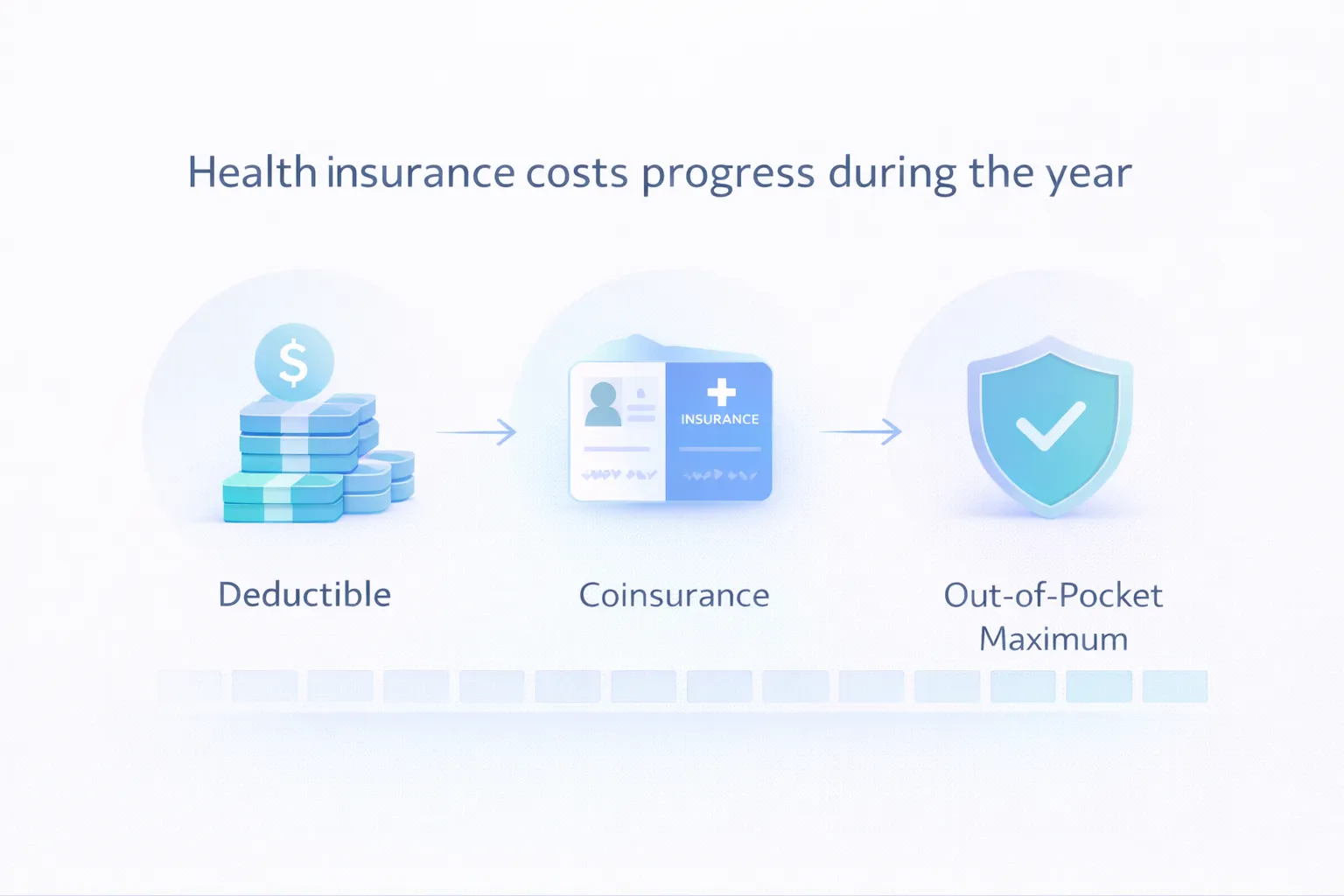
- Deductible = what you pay before insurance shares costs
- Coinsurance = the percentage you pay after the deductible
- Out-of-pocket maximum = the most you'll pay in a year
- Premiums = what you pay to keep coverage; they do not count toward either number
The difference between a deductible and an out-of-pocket maximum determines how much you actually pay for healthcare during the year. This guide explains how both work and includes a calculator to estimate your costs. CostKits also publishes a free Deductible Strategy Workbook - a print-and-fill companion to this guide with a where-am-I calculator and a now-vs-wait worksheet for timing care - which we'll email you from the signup box below.
Most people focus only on their deductible and miss the bigger picture: your out-of-pocket maximum is your real financial ceiling. That's the total amount you'll pay before your insurance covers everything at 100%. Yet many families don't know this number and end up with bill shock when unexpected healthcare costs arrive.
Understanding these two numbers - and how they interact - is essential for budgeting and planning your healthcare finances. They determine exactly when your insurance stops being a copayment or coinsurance share and starts covering everything. Plus, both reset every January, so last year's progress doesn't help you this year. If you're trying to figure out where you stand right now, see Will I hit my deductible this year? for a month-by-month way to estimate it.
This page walks you through exactly how each works, then shows you an interactive calculator to see what you'd pay in different scenarios.
Start Here: Find These 3 Numbers
Before you use any calculator or schedule care, open your insurer portal or the Summary of Benefits and Coverage and write down:
| Number | Where to find it | Why it matters |
|---|---|---|
| Deductible remaining | Claims summary or accumulator page | Tells you how much of the next bill you may pay before insurance shares costs |
| Coinsurance | Benefit summary for the service type | Tells you your percentage after the deductible is met |
| Out-of-pocket max remaining | Claims summary or accumulator page | Tells you the most more you can owe for covered in-network care this plan year |
If you only know your full deductible and full out-of-pocket max, pause here and find the remaining amounts. Bing, calculators, and provider estimates all get less useful when they ignore what you have already spent this year.
The Difference Between a Deductible and Out-of-Pocket Maximum
Here's the essential breakdown:
Met your deductible or nowhere close? The answer changes what the same care costs you this year.
The free Deductible Strategy Workbook gives you:
- ✓ A where-am-I calculator that pins down exactly where you stand on your deductible
- ✓ A now-vs-wait decision worksheet for timing care before or after your plan resets
- ✓ Worked examples showing how timing the same procedure changes what you owe
- ✓ A year-end planning checklist to run before your deductible starts over
- ✓ Print-and-fill - sit down with your EOBs once and know your number
Free - we'll email it to you now.
We'll send a sign-in link to your email - click it to get your guide. No account required, no spam.
| Term | What It Means |
|---|---|
| Deductible | What you pay out of your own pocket before insurance shares costs |
| Coinsurance | The percentage you pay after the deductible (typically 10–20%) |
| Out-of-Pocket Max | The most you'll pay in a year for in-network care (after that, insurance covers 100%) |
Key point: Once you hit your out-of-pocket maximum, your insurance covers 100% of eligible charges for the rest of the year. Your deductible is part of that maximum - not separate from it.
What Counts Toward Each Number?
This is where families get tripped up. Not every healthcare dollar moves every accumulator.
| Payment | Counts toward deductible? | Counts toward OOP max? |
|---|---|---|
| Allowed amount you pay before deductible | Usually yes | Usually yes |
| Coinsurance after deductible | No, deductible is already met | Usually yes |
| Copay | Sometimes, depends on plan | Usually yes for covered in-network care |
| Monthly premium | No | No |
| Out-of-network balance bill | Usually no | Often no or limited |
| Non-covered service | No | No |
| Preventive care covered at $0 | No patient payment | No patient payment |
When in doubt, use your insurer's accumulator page rather than a bill. Bills show what a provider wants to collect; the accumulator shows what your plan has actually credited toward your deductible and out-of-pocket maximum.
How to Find Your Deductible and Out-of-Pocket Maximum
If you don't already have these numbers written down, here's where to find them:
- Locate your Summary of Benefits and Coverage (SBC). Every ACA-compliant plan has one - it's a standardized 8-page document your insurer or HR department is required to provide. It lists your deductible, coinsurance percentage, and out-of-pocket maximum in the same place on every plan, which makes it easier to compare than a full policy document.
- Find your deductible and coinsurance percentage on the SBC's summary table, usually on page 1.
- Find your out-of-pocket maximum, listed separately - don't assume it equals your deductible, they're rarely the same number.
- Check your insurer's accumulator or claims portal for what you've already paid toward each number this plan year. The SBC shows your plan's limits; the portal shows your progress against them.
- Compare your remaining deductible against your remaining out-of-pocket max before scheduling non-urgent care - the gap between the two tells you how much coinsurance exposure is still ahead of you this year.
If you can't find your SBC, call the number on your insurance card and ask for your deductible, out-of-pocket maximum, and current accumulator balances - member services can read all three off your account directly.
See How Your Insurance Plan Works
Enter your deductible, coinsurance percentage, and a few typical visits to see how costs move through each stage of your plan. The calculator shows exactly when you'll hit your deductible, when coinsurance kicks in, and when you reach your out-of-pocket max.
This calculator shows how costs move through your deductible, coinsurance, and out-of-pocket maximum.
Turn the Calculator Into a Care-Timing Decision
Once you know where you are, use the result this way:
| If the calculator shows... | What it means | Best next move |
|---|---|---|
| You are far from the deductible | You may pay most scheduled care yourself | Compare facilities and ask for cash/self-pay alternatives before scheduling |
| You are close to the deductible | One procedure may change the cost of the next one | Group necessary care after the deductible is met if clinically appropriate |
| You are close to the OOP max | Additional in-network covered care may become low-cost or $0 | Ask whether delayed care should happen before the plan year resets |
| Your plan resets soon | This year's progress may disappear | Compare "do it now" vs "wait until after reset" before booking elective care |
The workbook in the email box on this page is built for this exact step: one worksheet for where you stand today, and one worksheet for deciding whether to schedule now or wait.
Example: A $1,500 Deductible Plan
Let's walk through a realistic scenario. Imagine your plan has:
- Deductible: $1,500
- Coinsurance: 20% (you pay 20%, insurance pays 80%)
- Out-of-Pocket Maximum: $5,000
Here's how three visits would be handled:
| Service | Billed Cost | Your Responsibility | Running Total |
|---|---|---|---|
| Specialist visit | $250 | $250 (toward deductible) | $250 |
| CT scan | $650 | $650 (toward deductible) | $900 |
| Emergency room visit | $1,500 | $600 (remaining deductible) + $180 (20% of remaining $900 after deductible) | $1,680 |
What happened:
- First two visits ($250 + $650 = $900): You pay the full amount because you haven't met your deductible.
- Emergency room visit ($1,500 billed): You pay $600 to complete your deductible, then coinsurance (20%) on the remaining $900 balance = $180. Total: $780 for that visit.
- Your out-of-pocket cost: $250 + $650 + $780 = $1,680 so far (you have $3,320 left before hitting your $5,000 OOP max).
Once you've paid $5,000 in deductibles and coinsurance combined, your insurance covers 100% of the next eligible charge.
Why Planning Matters
Most people focus only on their deductible and ignore the out-of-pocket maximum. That's a mistake. Here's why:
• Deductibles reset every year - Your progress toward it in December won't help in January. • Coinsurance adds up quickly - Even a 20% share of expensive procedures can exceed thousands of dollars. • The out-of-pocket max is your real exposure - That $5,000 number is what you actually need to plan for.
The critical insight: A $5,000 out-of-pocket maximum means the worst-case healthcare cost this year could be $5,000 (plus your premiums, which don't count toward the max). That's your financial ceiling.
If you have three family members on your plan, and your family out-of-pocket maximum is $10,000, that's your total household risk - even if one family member faces a serious illness requiring multiple procedures.
The calculator above shows you exactly when you'll hit each threshold, so you can budget accordingly.
What Affects Your Deductible and Out-of-Pocket Max
Your specific deductible and out-of-pocket maximum depend on:
- Plan type: HMO, PPO, EPO, or HDHP plans have different structures.
- Network status: Out-of-network care has much higher (or unlimited) out-of-pocket costs.
- Covered services: Some services (like preventive care) may be covered before you meet your deductible.
- Family vs. individual: Family plans have higher deductibles and OOP maximums.
During open enrollment (typically November–December), compare plans side by side. Don't just look at the premium - calculate the total cost (premium + expected out-of-pocket) for your situation.
Common Mistakes People Make
Mistake 1: Assuming your deductible is your worst-case cost. Reality: Your out-of-pocket maximum is your true ceiling. After that, insurance covers everything.
Mistake 2: Assuming copays always count toward your deductible. Reality: Copays usually count toward your out-of-pocket maximum for covered in-network care, but many plans do not count them toward the deductible. Check your plan's accumulator page.
Mistake 3: Forgetting the deductible resets January 1. Reality: Your progress toward the deductible doesn't carry over to the next year.
Mistake 4: Ignoring network status. Reality: Out-of-network providers can cost 2–3× more and have higher (or unlimited) out-of-pocket costs.
Common Questions
Should I get a lower deductible or lower out-of-pocket max? If you expect significant healthcare costs, prioritize the lower out-of-pocket maximum - it's your total cost exposure. If you're generally healthy, a higher deductible with lower premiums may save money overall.
What if I don't reach my deductible before year-end? Your unused deductible doesn't roll over to next year. It resets on January 1. However, if you know you'll have procedures in December, try to schedule them while you can apply your remaining deductible.
Do preventive services count toward my deductible? No. Preventive services (like annual physicals, vaccinations, and cancer screenings) are covered at 100% before you meet your deductible, per the Affordable Care Act.
What if I go out-of-network? Out-of-network providers typically have much higher deductibles and out-of-pocket maximums (sometimes unlimited). Always check if your provider is in-network before scheduling.
Before You Leave This Page
Write down your deductible remaining, out-of-pocket max remaining, and coinsurance percentage. Then keep that note with your next estimate, bill, and EOB. Those three numbers explain why a CT scan, colonoscopy, MRI, or surgery can cost five different amounts for five different people.
If you want the printable version, use the email box on this page for the free Deductible Strategy Workbook. It turns this guide into a one-page tracker you can reuse every time a new bill or procedure comes up.
Related Cost Information
Related Articles
Interested in understanding healthcare costs and managing your medical expenses?
- Deductible vs Out-of-Pocket MaximumLearn how insurance cost-sharing works and what you actually pay
- Cost ExplorerBrowse procedures and compare prices across the country
- CT Scan Cost GuideFind detailed CT scan pricing for your state
- MRI Cost GuideCompare MRI pricing and understand imaging costs
- X-Ray Cost GuideCompare X-ray pricing across states - one of the most affordable imaging procedures
- Colonoscopy Cost GuideUnderstand colonoscopy pricing and your out-of-pocket costs by insurance type
- New GuidesExplore our latest healthcare guides on costs, insurance, and medical billing
About the Author
John Caruso, FSA, MAAA
Healthcare actuary with 20+ years of experience in insurance pricing, medical billing systems, and healthcare cost analytics.
Connect on LinkedIn →Ready to take control of your healthcare costs?
Use the free cost estimator → · Get your bill screened for free → · See the family plan →