
Check your medical bill before you pay it.
CostKits compares your bill with your insurer's Explanation of Benefits, checks your charges against Medicare benchmark pricing, and gives you a personalized action plan.
Start free. Complete review: $29 flat. No percentage of your savings.
Sign in free to upload your bill - it takes about a minute.
- ✓Built by a healthcare actuary with 20+ years of experience
- ✓Independent - not paid by your hospital or insurer
- ✓Analysis and action materials, not a percentage-of-savings negotiator
- ✓Checks billed charges against Medicare benchmark pricing, not just your own paperwork
One price, regardless of what we find
Some medical-bill services charge a percentage of the savings they negotiate. Their fee generally increases with the verified reduction, subject to their caps and terms. CostKits charges $29 for its analysis regardless of the outcome - whether the amount in question is $100 or $10,000.
How CostKits reviews your medical bill
-
1
Upload the provider bill. CostKits extracts the amount due, service dates, provider, and available line items.
-
2
Add the corresponding Explanation of Benefits. CostKits compares what the provider requests with what your insurer says you owe.
-
3
Receive categorized findings. Confirmed mismatches, missing information, and price concerns are presented separately - never blended into one alarming number.
-
4
Get an action plan. The complete $29 review includes relevant questions, call scripts, and draft dispute letters where appropriate.
What CostKits can - and can't - determine
CostKits CAN determine
- ✓Whether your bill and EOB or MSN dollar amounts reconcile
- ✓Whether the arithmetic on your bill is internally consistent
- ✓Whether line items appear to be duplicated
- ✓Whether your claim has finished processing or is still pending
- ✓Whether your bill is itemized enough to review in detail
- ✓What document you still need before a review is possible
- ✓Whether a billed charge runs high relative to Medicare/CMS benchmark pricing, in the full paid review
CostKits CANNOT determine
- ●Whether a provider or insurer will actually reduce your balance
- ●That a high price is automatically a billing error - a benchmark comparison flags a concern, it doesn't establish one
- ●The outcome of a dispute or appeal you choose to file
- ●Facts not printed on the documents you provide
CostKits provides analysis and action materials. It does not place calls or negotiate with a provider or insurer on your behalf.
Example medical-bill review
Two real outcomes a review can produce - a confirmed mismatch, and a bill that turns out to be correct.
- Provider bill
- $846
- EOB patient responsibility
- $612
- Difference
- $234
Finding: Confirmed mismatch. The provider statement requests $234 more than the EOB lists as patient responsibility.
Recommended next step: Contact the provider's billing department and ask it to reconcile the statement with the processed insurance claim before paying.
- Provider bill
- $846
- EOB patient responsibility
- $846
- Difference
- $0
Finding: No dollar mismatch identified. The documents agree, although an itemized statement may still be required for a code-level review.
Recommended next step: No dispute is indicated on the dollar amounts. You can still request an itemized bill if you want to review individual charges.
Inside your CostKits review
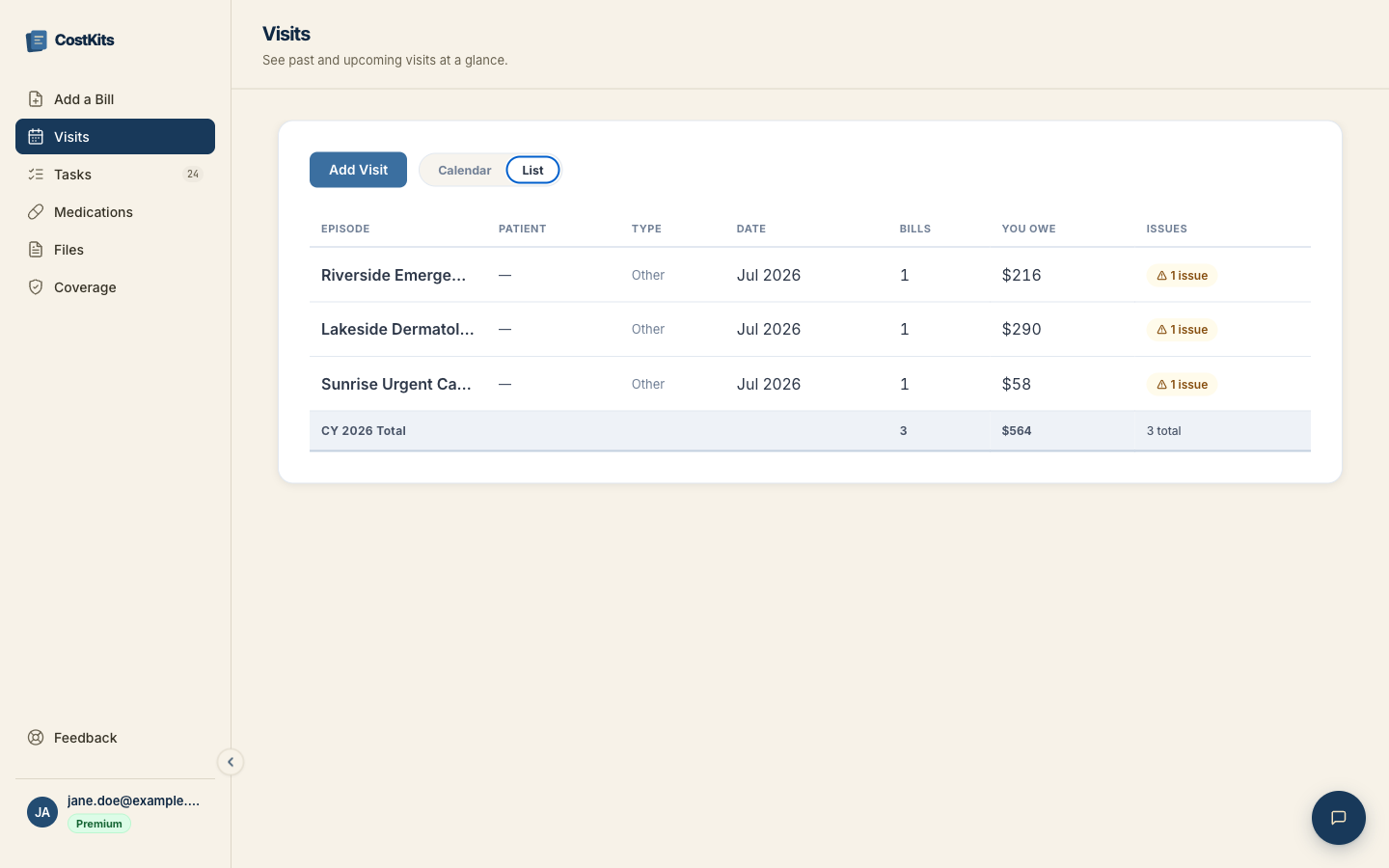
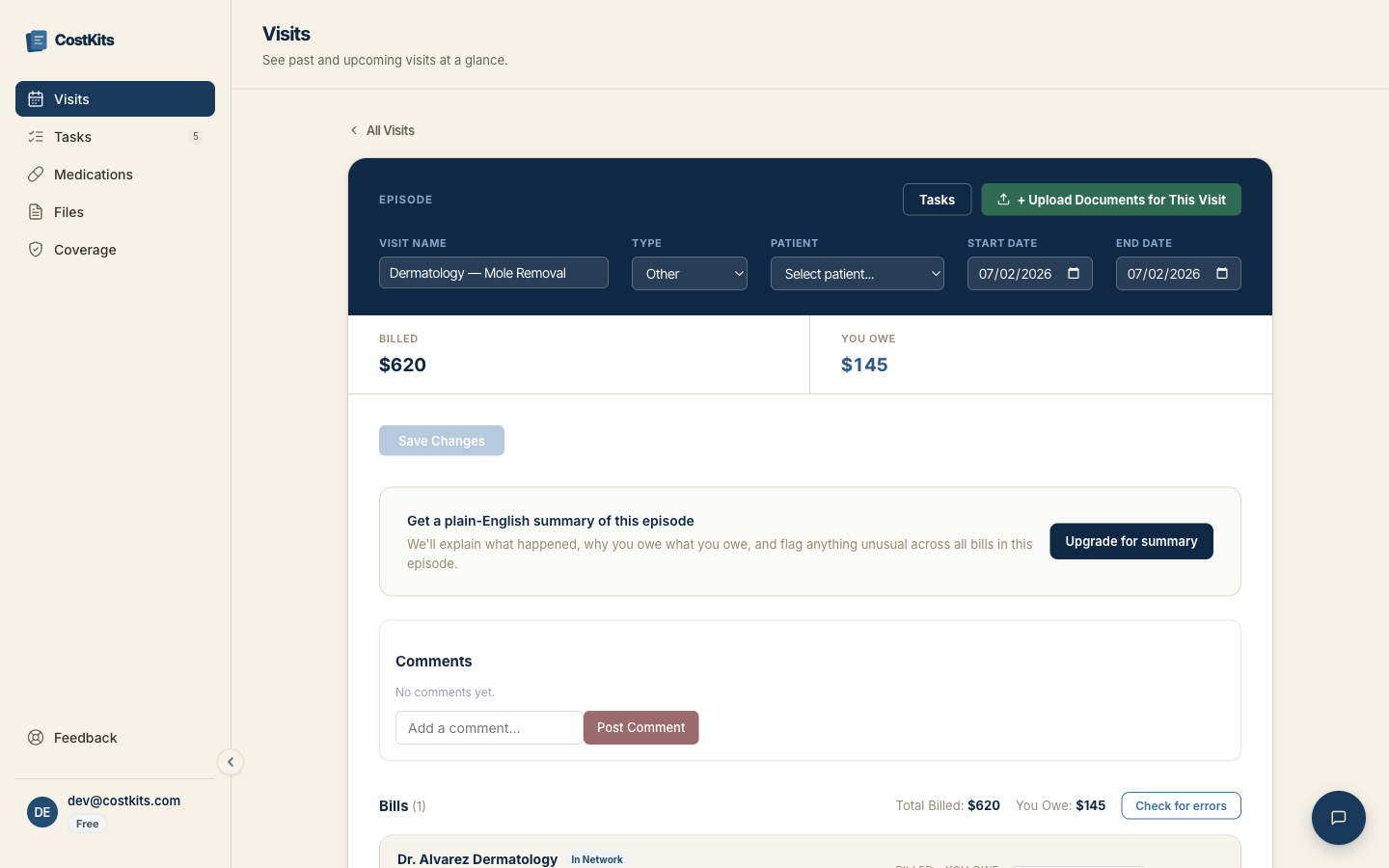
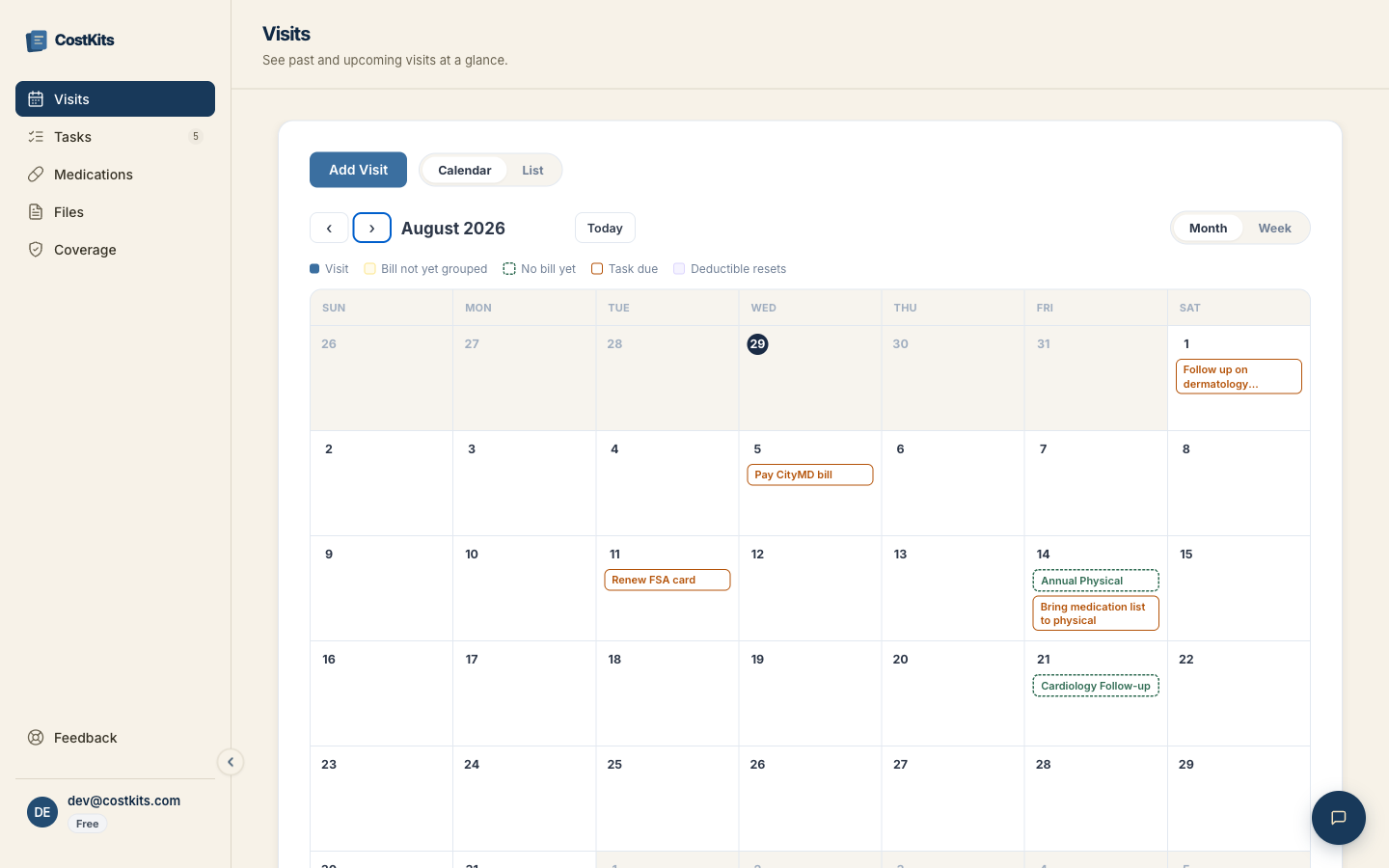
A completed review doesn't just tell you something's wrong - it gives you an organized record and a plan you can act on. Here's what that looks like with a real (mock) example account.

Frequently asked questions
What is a medical bill EOB checker?
A medical bill EOB checker compares your provider bill line-by-line against your insurer's Explanation of Benefits - that document shows what your insurer determined you actually owe. Sign in free above to see whether you already have what's needed to make that comparison.
Is an EOB the same as a bill?
No. An EOB (explanation of benefits) is a statement from your insurer showing how a claim was processed - it is not a request for payment. Your provider bill is the actual request for payment. You need both documents to check whether what you're being asked to pay matches what your insurer says you owe.
Can a provider bill more than my EOB says I owe?
It happens, and it's one of the most common reasons a bill and an EOB don't match. It can reflect a real billing error, a claim that hasn't finished processing, or a timing difference between the two documents. An independent review compares the two documents and tells you which of those is most likely.
What does patient responsibility mean on an EOB?
Patient responsibility is the dollar amount your insurer determined you owe after applying your deductible, copay, and coinsurance - separate from what the provider originally billed. It's the figure your provider bill should ultimately match.
How is a $29 flat-fee review different from a percentage-of-savings service?
Percentage-based services typically charge a share of whatever savings they find or negotiate, so their fee generally increases with the verified reduction, subject to their caps and terms. CostKits charges $29 for its analysis regardless of the outcome - the price doesn't depend on what's found. CostKits provides analysis and action materials; it does not place calls or negotiate with a provider or insurer on your behalf.
What can CostKits determine, and what can't it determine?
CostKits can determine whether your bill and EOB or MSN reconcile, whether the arithmetic on your bill is internally consistent, whether documents appear to be duplicated, whether your bill is itemized enough to review in detail, and - in the full paid review - whether a billed charge runs high relative to Medicare/CMS benchmark pricing. It cannot guarantee a provider will reduce a balance, negotiate directly with your provider or insurer, or declare a high price a billing error just because it's high - a benchmark comparison flags a concern, it doesn't establish an error.
Can't I just compare my bill to my EOB myself, for free?
Yes - requesting an itemized bill and comparing it line-by-line against your EOB is a real, valid, and free first step, and it's worth doing regardless of whether you pay for anything. What that comparison can't tell you is whether a charge that matches your EOB is itself reasonable - your EOB reflects your plan's contracted rate, not whether that rate is high relative to Medicare or CMS benchmark pricing. That benchmark comparison is what the paid review adds on top of the free comparison, not a replacement for it.
How much does an independent medical bill review cost?
A one-time review is $29 flat and covers one billing case, regardless of what's found. If you're managing bills for yourself, a family member, or as a caregiver on an ongoing basis, a CostKits membership ($15/month or $150/year) covers unlimited bills.
Do I need to pay before I know if my bill has a problem?
No. Sign in free with your email or Google account, upload your bill, and see whether it's a good candidate for review before paying anything. The $29 charge only applies if you move forward with the full independent review.
What if I don't have my Explanation of Benefits yet?
Sign in free and start your bill upload - CostKits will tell you exactly what's missing. We don't recommend paying for a review until both sides of the paperwork are in hand - without the insurer's statement, there's nothing to compare the bill against. See our guide to reading your medical bill for more on what to look for yourself.
Sources and methodology
CostKits' document-matching approach is based on the patient-responsibility fields shown on insurer EOBs and Medicare Summary Notices. Review our data and pricing methodology and the official Medicare guidance for reading an MSN for more detail. For general background on your rights around medical billing, see the CMS No Surprises Act consumer resources.