
Learn the critical difference between an EOB and medical bill, how to use them together to catch billing errors, and avoid overpaying for healthcare with our complete step-by-step guide.
EOB vs Medical Bill: The Complete Guide to Understanding Healthcare Documents
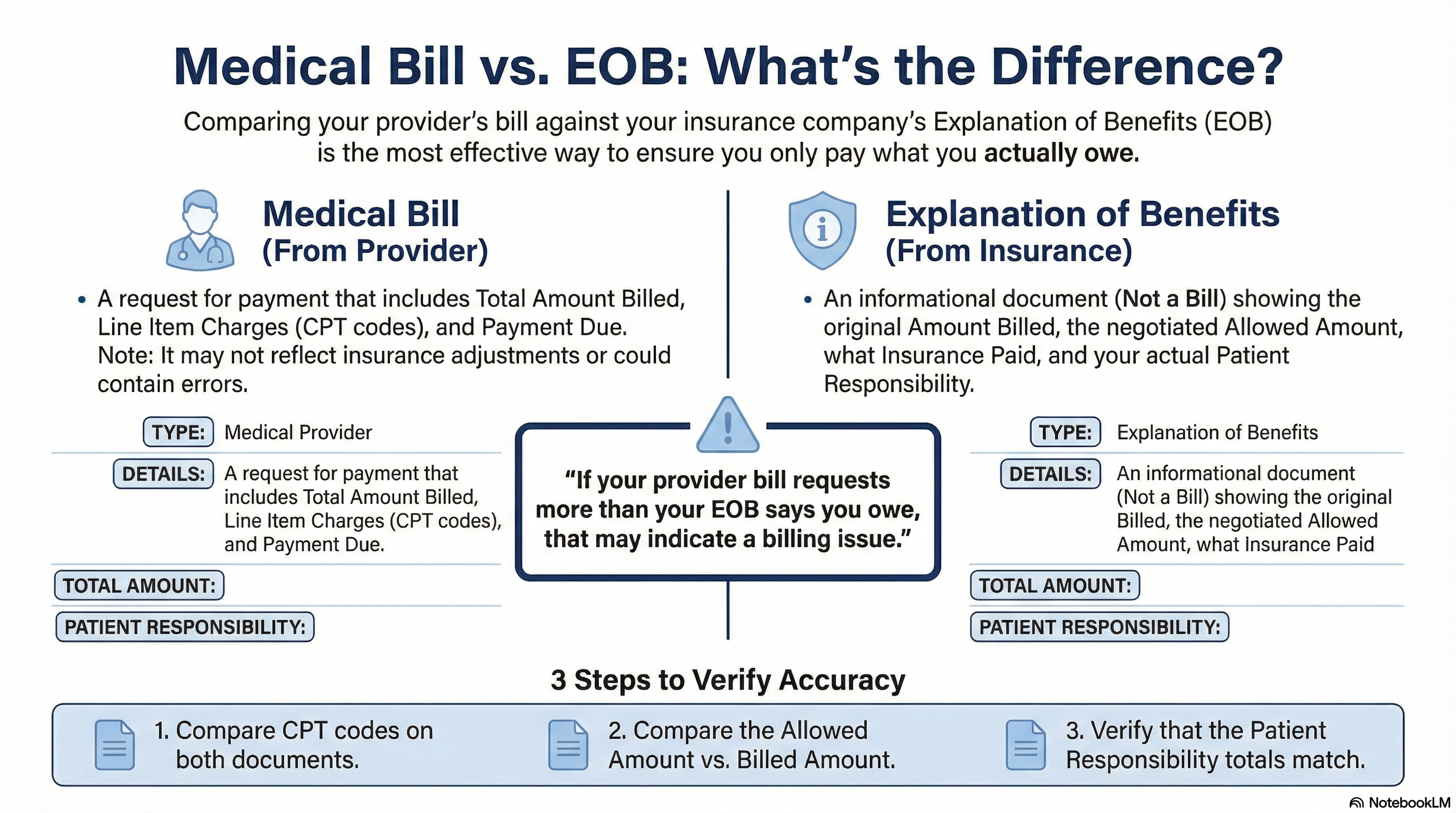
Quick Answer: An Explanation of Benefits (EOB) comes from your health insurance company and shows how they processed your claim - it's not a bill. A medical bill comes from your healthcare provider requesting payment. The EOB helps you verify that your medical bill is correct before paying.
Understanding the difference between these two critical healthcare documents can save you hundreds or thousands of dollars. Don't pay a medical bill without first comparing it to your EOB - this simple step catches 4 out of 5 billing errors. You can check whether your EOB and medical bill are ready for a professional comparison using our free bill screener before paying.
Compare Your Bill to Your EOB
Use our free medical bill checker to spot duplicate charges and balance billing errors instantly.
Compare Your Bill to Your EOB →Table of Contents
- What is an EOB (Explanation of Benefits)?
- What is a Medical Bill?
- EOB vs Medical Bill: Side-by-Side Comparison
- Why EOBs and Medical Bills Often Don't Match
- How to Use Your EOB to Verify Your Medical Bill (Step-by-Step)
- Real Example: EOB vs Medical Bill Analysis
- Common EOB and Medical Bill Mistakes to Avoid
- When to Dispute or Appeal
- How CostKits Simplifies EOB and Medical Bill Management
- Frequently Asked Questions
- Key Takeaways
What is an EOB (Explanation of Benefits)?
An Explanation of Benefits (EOB) is a detailed statement from your health insurance company that explains:
- What medical services were provided
- How much the provider originally charged
- The negotiated "allowed amount" with your insurer
- How much your insurance paid
- What you're responsible for paying (copays, deductibles, coinsurance)
Key point: EOBs typically include the disclaimer "This is not a bill" because they're for your information only. According to Healthcare.gov, an EOB is an official government-recognized document that helps you understand your healthcare coverage and costs.
What an EOB Shows You
- Provider charges: The original amount billed by your healthcare provider
- Allowed amount: The negotiated rate your insurance company agreed to pay
- Plan discount: The difference between the provider charge and allowed amount
- Insurance payment: What your insurance company actually paid
- Patient responsibility: Your share (copays, deductibles, coinsurance)
- Claim status: Whether the claim was approved, denied, or requires additional information
What is a Medical Bill?
A medical bill (also called a provider statement) is a request for payment from your healthcare provider. It should include:
- Date of service
- Description of services provided
- Procedure codes (CPT/HCPCS codes)
- Diagnosis codes (ICD codes)
- Amount charged
- Insurance payments received
- Patient balance due
Unlike an EOB, a medical bill requires action - it's asking you to pay the balance due.
Your EOB has one number that decides what you owe - and it isn't the billed amount.
The free EOB Decoder gives you:
- ✓ A line-by-line key to every field on the page, in the order it appears
- ✓ Where the allowed amount actually comes from - and why it's lower than the billed charge
- ✓ The one number that must match between your EOB and your bill
- ✓ A short checklist for when the two documents disagree
- ✓ Print-and-keep - decode any EOB in one pass
Free - we'll email it to you now.
We'll send a sign-in link to your email - click it to get your guide. No account required, no spam.
EOB vs Medical Bill: Side-by-Side Comparison
| Feature | EOB (from insurer) | Medical Bill (from provider) |
|---|---|---|
| Who sends it | Health insurance company | Doctor, hospital, clinic, lab |
| Purpose | Explain claim processing | Request payment |
| Shows negotiated rates | Yes (allowed amount) | Usually only shows final balance |
| "Amount owed" | Estimate of your responsibility | Actual balance due |
| Includes procedure codes | Yes, with detailed breakdown | Often included; request itemized bill if missing |
| When to call first for errors | Insurance company | Healthcare provider |
| Legal requirement to pay | No - informational only | Yes - payment requested |
Before you pay a medical bill, compare it to your EOB.
Use our free tool to spot duplicate charges and balance billing errors that could save you hundreds of dollars.
Check My Bill NowWhy EOBs and Medical Bills Often Don't Match
It's common for the "amount you owe" on your EOB to differ from your medical bill. Here's why:
1. Timing Differences
- EOBs often arrive before medical bills
- Providers may not have received insurance payment when they sent your bill
- Multiple claims for the same visit may be processed separately
2. Coordination of Benefits
- If you have multiple insurance plans, each may process claims differently
- Primary and secondary insurance coordination can create discrepancies
3. Billing Errors
- Duplicate charges
- Incorrect procedure codes
- Wrong insurance information
- Balance billing (charging more than the allowed amount)
4. Incomplete Information
- Some bills lack detailed procedure codes
- Missing insurance adjustments
- Unclear payment allocations
How to Use Your EOB to Verify Your Medical Bill (Step-by-Step)
Step 1: Match Basic Information
Verify that both documents show:
- Same patient name
- Same healthcare provider
- Same date of service
- Same or corresponding procedure codes
- Same claim or account numbers
Step 2: Check the Allowed Amount
Your cost should be based on the insurance company's "allowed amount," not the provider's original charge. For in-network providers, you should never pay more than your share of the allowed amount.
Step 3: Calculate Your Responsibility
Using the EOB, verify your patient responsibility:
- Copays: Fixed amount per visit
- Deductible: Amount you pay before insurance kicks in
- Coinsurance: Your percentage of the allowed amount (e.g., 20%)
Step 4: Compare Totals
If your medical bill is higher than the patient responsibility shown on your EOB, there may be an error.
Step 5: Request Clarification
If amounts don't match:
- Contact the provider's billing department first
- Ask for an itemized bill if you don't have one
- Reference your EOB and ask them to reconcile the difference
- Contact your insurance company if needed
Real Example: EOB vs Medical Bill Analysis
Scenario: Doctor visit for annual physical
Provider's Original Charge: $1,200 Insurance Allowed Amount: $600 (negotiated rate) Insurance Pays: $480 (80% of allowed amount) Your Coinsurance: $120 (20% of allowed amount)
What Your EOB Should Show:
- Provider charge: $1,200
- Plan discount: $600
- Allowed amount: $600
- Insurance payment: $480
- Patient responsibility: $120
What Your Medical Bill Should Show:
- Balance due: $120
Red Flag: If your medical bill shows $300 due instead of $120, you need to resolve this discrepancy before paying. If you're comparing charges for diagnostic imaging like CT scans, understanding price variations helps you negotiate or verify charges.
Common EOB and Medical Bill Mistakes to Avoid
1. Paying Before Getting Your EOB
Problem: You might overpay or pay for services that should be covered Solution: Wait for your EOB to arrive, or verify that insurance has processed the claim
2. Assuming the EOB Amount is Final
Problem: EOBs can be wrong if there are coding errors or missing information Solution: If you think there's an error, request reprocessing from your insurance company
3. Accepting Vague Medical Bills
Problem: Bills without procedure codes make it impossible to verify against your EOB Solution: Always request an itemized bill with CPT/HCPCS codes. You can use our free anonymous medical bill checker to spot errors even on unclear bills
4. Missing Duplicate Charges
Problem: Providers sometimes bill for the same service multiple times Solution: Compare line items on your EOB to spot duplicates, then ask the provider to remove them
5. Not Appealing Obvious Errors
Problem: Both insurance companies and providers make mistakes Solution: Don't hesitate to question charges that seem incorrect
When to Dispute or Appeal
You should challenge billing discrepancies when:
- Your medical bill exceeds the patient responsibility shown on your EOB for in-network care
- Your EOB shows a denial code you believe is incorrect
- Preventive services are billed as diagnostic without explanation
- You spot obvious errors (wrong patient, date, or provider)
- Duplicate charges appear on either document
- You're balance billed above the allowed amount by an in-network provider
The Centers for Medicare & Medicaid Services (CMS) has established patient rights regarding billing accuracy and balance billing protections under the No Surprises Act that you should know when disputing charges.
If you're unable to pay a disputed bill: Understand what happens when medical bills go unpaid, including the collections timeline, your 30-day dispute window under FDCPA, and new 2025 protections that prevent medical debt from appearing on credit reports.
How CostKits Simplifies EOB and Medical Bill Management
Managing EOBs and medical bills manually is time-consuming and error-prone. CostKits uses AI to help you compare and analyze them. You can start by using our free bill screener to check whether your paperwork is ready for a professional review:
AI-Assisted Document Comparison
- Upload your EOBs and medical bills to your CostKits vault
- Verify the AI-extracted details, then CostKits matches EOB and bill line items by procedure code
- Surfaces discrepancies and potential overcharges for you to review
Smart Bill Analysis
- Flags duplicate charges
- Highlights balance billing issues
- Identifies coding errors
- Suggests next steps for resolution
Family-Friendly Organization
- Organize documents for your entire family
- Monitor deductibles and out-of-pocket maximums
- Forecast upcoming healthcare costs
Dispute Assistance
- Generate dispute letters and phone scripts for billing disputes
- Practice conversations with AI chatbots before calling providers
- Store all documentation in one secure location

CostKits groups all the bills from a single visit and breaks each one down to what you actually owe, flagging line items worth disputing.
Frequently Asked Questions
Is an EOB the same as a medical bill?
No. An EOB is an informational document from your insurance company showing how they processed your claim. A medical bill is a payment request from your healthcare provider.
What if my EOB says I owe $0 but I still got a bill?
This often happens due to timing or processing errors. Contact your provider's billing department to reconcile the difference. If needed, call your insurance company with your claim number.
Why is my medical bill higher than the allowed amount on my EOB?
For in-network services, you generally shouldn't be charged more than your portion of the allowed amount. This could be balance billing, which may violate your provider contract. Request clarification immediately.
How long should I wait for my EOB before paying a medical bill?
EOBs typically arrive within 30-60 days of service. If you haven't received one and got a bill, call your insurance company to check claim status before paying.
Can I negotiate my medical bill based on my EOB?
Yes. Your EOB shows the negotiated rates your insurance company secured. If you're uninsured or paying cash, you can reference these rates when negotiating with providers. Learn more about effective medical bill negotiation strategies and how CostKits can help you prepare for these conversations.
What if my insurance denied the claim on my EOB?
Review the denial reason code carefully. Common issues include:
- Missing prior authorization
- Service not covered under your plan
- Coding errors
- Out-of-network provider
Many denials can be appealed successfully with additional documentation. Healthcare.gov provides guidance on the appeals process and your rights as a patient.
Key Takeaways
- EOBs explain, bills request payment - Never confuse these two documents
- Use your EOB to verify medical bills - Don't pay without comparing first
- The allowed amount matters most - Your costs are based on negotiated rates, not original charges
- Discrepancies are common - Don't assume either document is automatically correct
- You have rights - Challenge errors and request itemized bills when needed
- Technology can help - Tools like CostKits automate the comparison process and catch errors you might miss
Understanding EOBs and medical bills empowers you to catch billing errors, avoid overpaying, and make informed healthcare financial decisions. When used together, these documents provide a complete picture of your healthcare costs and help ensure you're only paying what you actually owe.
Ready to check your own bill? Compare your bill with your EOB → - start free, then get a complete independent review for $29 flat.
Related Cost Information
Related Articles
Interested in understanding healthcare costs and managing your medical expenses?
- Understanding Your UnitedHealthcare EOBCostKits helps families analyze UnitedHealthcare EOBs and often finds errors that could cost families money. AI instantly decodes complex EOBs and flags discrepancies.
- How to Read Your Medical Bill: A Step-by-Step Guide for FamiliesCostKits AI helps families analyze medical bills and often finds errors that could cost families money. Skip the learning curve with our automated bill analysis and professional negotiation.
- How to Negotiate Medical Bills (And When Not To)Most guides give one script for negotiating medical bills, no matter why the bill is high. Run the Bill Negotiability Triage first to find out whether your bill needs a negotiation call, a formal dispute, or a financial-assistance application.
- How to Write a Claim Appeal Letter: Step-by-Step Federal RequirementsFederal law gives you the right to appeal denied claims. This complete guide shows what information to include in your appeal letter, based on HealthCare.gov and CMS regulations, plus practical tips from the Patient Advocate Foundation.
About the Author
John Caruso, FSA, MAAA
Healthcare actuary with 20+ years of experience in insurance pricing, medical billing systems, and healthcare cost analytics.
Connect on LinkedIn →Ready to take control of your healthcare costs?
Use the free cost estimator → · Get your bill screened for free → · See the family plan →