Learn realistic healthcare budgeting based on your household size, insurance plan, and age. Use our calculator to forecast your annual healthcare costs.
How Much Should You Budget for Healthcare Each Year?
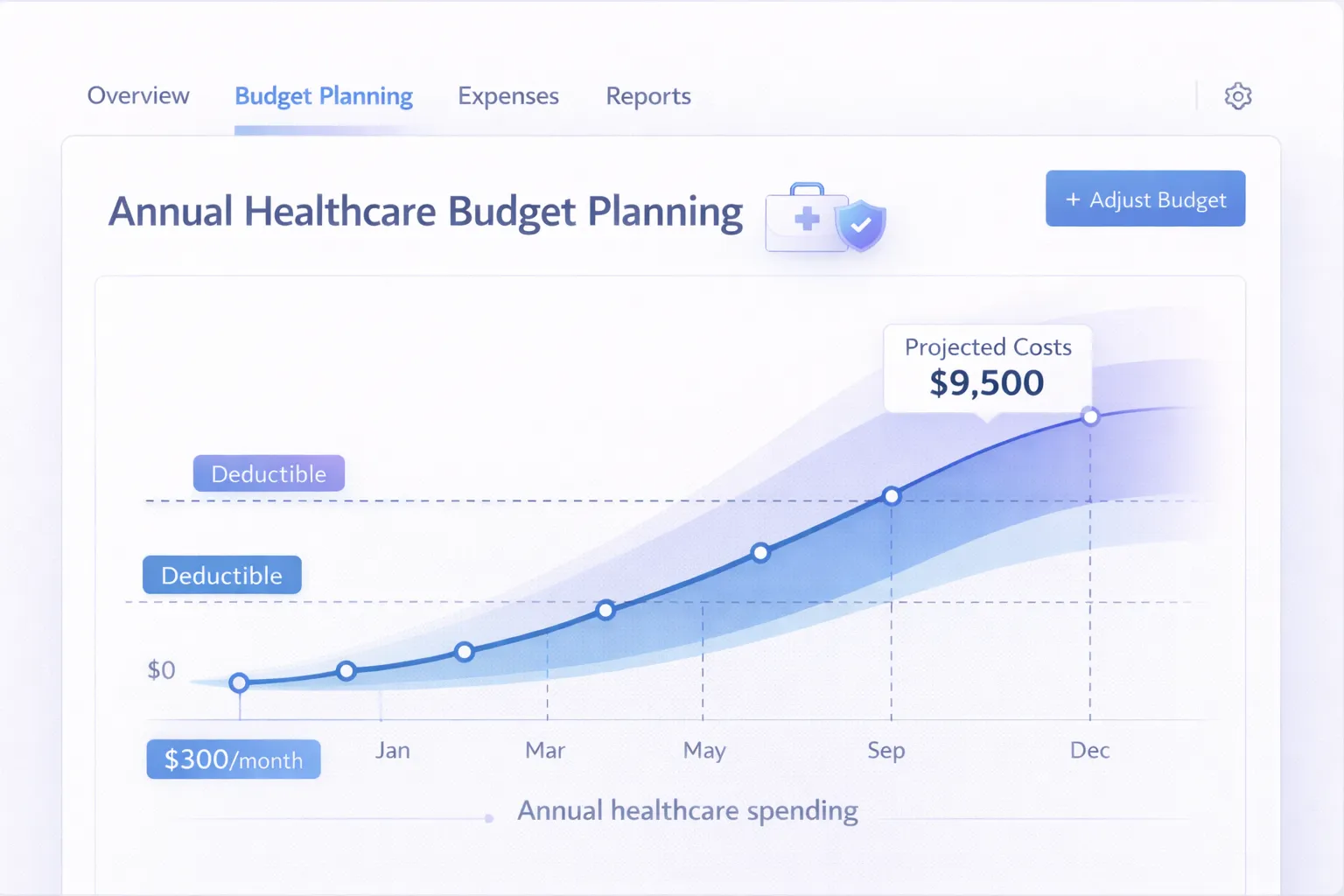
Healthcare costs are one of the largest expenses most American families face, yet many don't have a clear understanding of what they should budget. Without proper planning, unexpected medical bills can derail your finances and leave families scrambling. The key to financial peace of mind is understanding your likely healthcare costs and planning accordingly.
Table of Contents
- Average healthcare spending in the US
- How insurance design affects your healthcare budget
- Typical healthcare spending scenarios
- Building a healthcare emergency fund
- Try the healthcare cost calculator
- Frequently asked questions
At CostKits, we've analyzed millions of medical bills to understand real healthcare spending patterns. The average American family spends significantly more on healthcare than they expect—and without proper budgeting, those costs can become a financial crisis.
Average Healthcare Spending in the US
What does the typical American family actually spend on healthcare each year? The answer depends on several factors: your household size, age, insurance plan, and health profile.
National healthcare spending statistics:
- The average individual spends $6,000-$8,000 annually on healthcare (including premiums, deductibles, and out-of-pocket costs)
- Families of four average $15,000-$22,000 per year across all healthcare expenses
- These figures include insurance premiums, deductibles, copays, coinsurance, and prescriptions
- Critical insight: Most families underestimate their annual healthcare costs by 30-50%
The variation is significant. A healthy 25-year-old might spend $3,000-$5,000 annually, while a 55-year-old with chronic conditions could exceed $15,000. Your actual spending depends on your specific situation, which is why generic "average" numbers often mislead families during budget planning.
Why averages don't work for your family:
The $6,000-$8,000 "average" includes everyone—from newborns to seniors with multiple health conditions. Your family's actual costs depend on:
- Your age and your spouse's age (if applicable)
- Your children's ages and health status
- Your insurance plan type (HMO, PPO, HDHP, Medicare, Medicaid)
- Your deductible and out-of-pocket maximum
- Chronic conditions requiring ongoing treatment
- Prescription medications you take
This is why comparing healthcare plans before enrollment is so important—the right plan can save thousands annually.
How Insurance Design Affects Your Healthcare Budget
Your insurance plan structure is the single biggest factor determining your healthcare budget. Two families with identical health situations can face vastly different costs based on their plan choice.
The key insurance metrics that drive your budget:
- Monthly Premium: Varies from $0 (employer-sponsored) to $500+ (individual market)
- Annual Deductible: $0-$15,000 depending on plan type and tier
- Copay/Coinsurance: $0-50% depending on what services you use
- Out-of-Pocket Maximum: $2,500-$8,850 (the annual cap on your costs)
Your insurance design creates a range of possible outcomes. In a best-case scenario (minimal medical needs), you might pay only your premium and a few copays. In a worst-case scenario (you hit your out-of-pocket maximum), you'll pay the maximum possible amount.
Understanding your insurance plan structure:
Many families choose their insurance plan based on monthly premium alone, without considering the deductible and out-of-pocket maximum. This is a critical mistake. A plan with a $50/month lower premium but a $5,000 higher deductible could cost you dramatically more.
Here's why plan design matters:
- Low-premium, high-deductible plans are best for healthy families with minimal expected medical needs
- Moderate-premium, moderate-deductible plans work for families who expect some medical services
- High-premium, low-deductible plans make sense for families with chronic conditions or planned procedures
Learn more about this crucial decision: understanding deductibles vs. out-of-pocket maximums helps you choose the right plan for your situation.
Typical Healthcare Spending Scenarios
Let's look at four realistic scenarios showing how different families with different insurance plans might spend:
Scenario 1: Healthy 30-year-old, HDHP plan
- Annual premium: $4,800 (employee + employer contribution)
- Deductible: $1,500
- Out-of-pocket max: $4,050
- Expected annual cost: $4,800 (if minimal care needed)
- Worst case: $4,800 + $4,050 = $8,850
Scenario 2: Family of 4 (ages 35, 33, 8, 5), PPO plan
- Annual premium: $18,000 (employee + employer contribution)
- Deductible: $2,500 (family)
- Out-of-pocket max: $7,000
- Expected annual cost: $18,000-$22,000 (routine care + preventive)
- Worst case: $18,000 + $7,000 = $25,000
Scenario 3: Self-employed couple, ages 45 & 47, PPO plan
- Annual premium: $24,000
- Deductible: $3,000
- Out-of-pocket max: $8,850
- Expected annual cost: $24,000-$28,000 (routine care)
- Worst case: $24,000 + $8,850 = $32,850
Scenario 4: Single parent with chronic condition, HMO plan
- Annual premium: $7,200
- Deductible: $0 (HMO)
- Copay: $40 per visit
- Out-of-pocket max: $4,500
- Expected annual cost: $7,200-$10,000 (regular appointments + medications)
- Worst case: $7,200 + $4,500 = $11,700
These scenarios show why generic budgets fail. A healthy family might spend $8,000-$12,000 annually, while a family with chronic conditions could exceed $35,000. The key is knowing your specific plan and estimating your likely usage.
Using your actual insurance data:
The best way to budget accurately is to use your insurance plan's actual numbers. If you're covered by an employer, your benefits summary (or benefits administrator) provides:
- Your employer contribution
- Your monthly premium
- Your deductible and out-of-pocket maximum
- Your copays and coinsurance percentages
This information lets you calculate your realistic range of possible costs.
Building a Healthcare Emergency Fund
Beyond budgeting for expected healthcare costs, smart families build an emergency fund specifically for healthcare. Even with insurance, unexpected medical events can create financial strain.
Why a healthcare emergency fund matters:
- Unexpected diagnoses can lead to procedures not covered by insurance
- Out-of-network care may be necessary in emergencies (costing more)
- Extended treatment might exceed your out-of-pocket maximum quickly
- Income loss due to illness compounds the financial impact
- Medical debt can affect your credit if you can't pay immediately
Building your healthcare safety net:
Financial experts recommend maintaining:
- 3-6 months of household expenses in general emergency savings
- $2,000-$5,000 additional specifically for healthcare emergencies
- Health Savings Account (HSA) contributions if available (triple tax-advantaged savings for qualified medical expenses)
For a family with $50,000 annual income and $3,000 out-of-pocket maximum, consider maintaining $7,000-$10,000 in healthcare-earmarked savings. For higher-income families, the emergency fund scales proportionally.
HSAs as healthcare financial tools:
If you have access to an HSA (through a High-Deductible Health Plan), max it out. You can contribute $4,150 (individual) or $8,300 (family) in 2024, and the money is:
- Tax-deductible on contribution
- Tax-free for medical expenses
- Grows tax-free
- Never expires (unlike FSAs)
This is the most tax-efficient way to save for healthcare costs.
Try the Healthcare Cost Calculator
Stop guessing about your healthcare budget. The calculator below shows your personalized forecast based on your household size, age, insurance plan details, and year-to-date spending.
Enter your information to get a realistic estimate of what you should budget for healthcare this year:
How to use this calculator:
- Household Size: Number of people on your insurance plan (self, spouse, children)
- Age: Primary policyholder's age (this significantly affects costs)
- Year-to-Date Spending: Total amount you've already paid for healthcare this year
- Deductible: Amount you must pay out-of-pocket before insurance starts paying
- Out-of-Pocket Maximum: Maximum you'll pay this year (includes deductible)
The forecast shows your likely spending range based on typical healthcare utilization patterns. If you have expected major procedures or know you'll use significant healthcare services, your actual costs may exceed the median projection.
Key Takeaways: Creating Your Healthcare Budget
- Understand your insurance plan structure - Premium, deductible, and out-of-pocket maximum are the key variables
- Don't choose plans by premium alone - Consider your expected healthcare needs and plan type
- Use the calculator to estimate your range - Different plan designs create different possible outcomes
- Build a healthcare emergency fund - Maintain $2,000-$5,000 specifically for unexpected medical costs
- Maximize HSA contributions if available - Triple tax-advantaged savings for health costs
- Review your budget annually - As your household changes, your healthcare needs and costs change too
Healthcare budgeting doesn't require complex formulas. It requires understanding your insurance plan and estimating realistically what you'll use. Most families undershoot by assuming "we're healthy so we won't use much care." Reality is more nuanced—even healthy families pay significant healthcare costs through insurance premiums and routine preventive care.
The families who budget best are the ones who start with a clear understanding of their plan and use data to estimate their costs. That's exactly what this calculator provides.
Frequently Asked Questions
Q: What's the difference between my deductible and out-of-pocket maximum?
Your deductible is the amount you pay before insurance starts helping. Your out-of-pocket maximum is the most you'll pay in a year for covered services. Once you hit your out-of-pocket max, insurance covers 100% of additional covered costs. For example, with a $2,500 deductible and $7,000 out-of-pocket max, you pay the first $2,500, then coinsurance until you reach $7,000 total, then insurance covers everything.
Q: Should I choose the cheapest insurance plan?
Not necessarily. A plan with lower premiums often has a higher deductible, meaning you'll pay more out-of-pocket when you use healthcare. Healthy families with minimal expected medical needs might benefit from lower-premium plans, while families with chronic conditions or planned procedures should consider plans with lower deductibles even if premiums are higher.
Q: How much should I save for a healthcare emergency?
Financial experts recommend maintaining $2,000-$5,000 in healthcare-specific emergency savings beyond your general emergency fund. If you have access to a Health Savings Account (HSA), maximize contributions ($4,150 individual / $8,300 family in 2024) since these funds are triple tax-advantaged for medical expenses.
Q: Does my forecast change during the year?
Yes. The calculator shows your projected year-end costs based on your year-to-date spending. As you spend more through the year, your remaining budget decreases. For example, if you've already spent $3,000 and your out-of-pocket maximum is $7,000, you only have $4,000 remaining to budget.
Q: What if I have a major procedure planned?
Update your year-to-date spending amount in the calculator once the procedure is complete. Your forecast will adjust to show realistic remaining costs. If you have a planned procedure, discuss with your provider's billing department beforehand to estimate your out-of-pocket costs.
Q: Are prescription medications included in my out-of-pocket maximum?
Usually yes, but check your specific plan documents. Most insurance plans count prescription drug costs (after copay/coinsurance) toward your out-of-pocket maximum, but some plans have separate drug maximums. Review your Summary of Benefits and Coverage (SBC) document to confirm.
Related Articles
Continue building your healthcare financial literacy:
- 5 Surprising Ways to Save on Healthcare Costs in 2025 - Immediate savings strategies
- Deductible vs. Out-of-Pocket Max: What Families Need to Know Before Their Next Appointment - Understand your plan structure
- How to Read an EOB Line by Line: Complete Breakdown - Understand what you're being charged
- How to Negotiate Your Medical Bills: A Patient's Playbook - Reduce what you owe after treatment
- How to Stop Medical Bill Problems Before They Start - Prevent billing issues proactively
About the Author
John Caruso, FSA, MAAA is a healthcare actuary with 20+ years of experience in insurance pricing, medical billing systems, and healthcare cost analytics. He founded CostKits to help families understand and control their healthcare expenses. Connect on LinkedIn →
Healthcare budgeting is personal. The numbers that matter are your numbers. Start with clear data about your insurance plan and your likely costs.